
Outdoor Kitchens & Outdoor Living Spaces in South Jersey
The Difference Is In the Details
Outdoor Kitchens & Outdoor Living Spaces in South Jersey: A 2026 Design and Cost Guide
An outdoor kitchen is one of the few backyard upgrades people actually use every week instead of looking at through the window. Done right, it becomes the spot where summer happens: dinner on a Tuesday, the whole family on a Saturday, friends who do not want to leave. Done wrong, it is an expensive grill island sitting on a slab that cracks the first hard winter.
We have been building outdoor living spaces across South Jersey since 1983, three generations of the same family. We self-perform the concrete and the masonry, which means the part nobody sees gets the same attention as the part everyone photographs. This guide walks through how a real outdoor living space comes together in 2026: what goes into one, what it costs here in Gloucester and Camden County, and the decisions that separate a kitchen that lasts thirty years from one that fails in three.
What this guide covers
- What an outdoor living space actually is
- It starts with the slab
- The anatomy of an outdoor kitchen
- Designing the whole space: zones, shade, fire, flow
- Materials that survive a South Jersey winter
- What it costs in South Jersey (2026)
- Permits, utilities, and timeline
- Is it worth it? ROI and the real reason
- Frequently asked questions
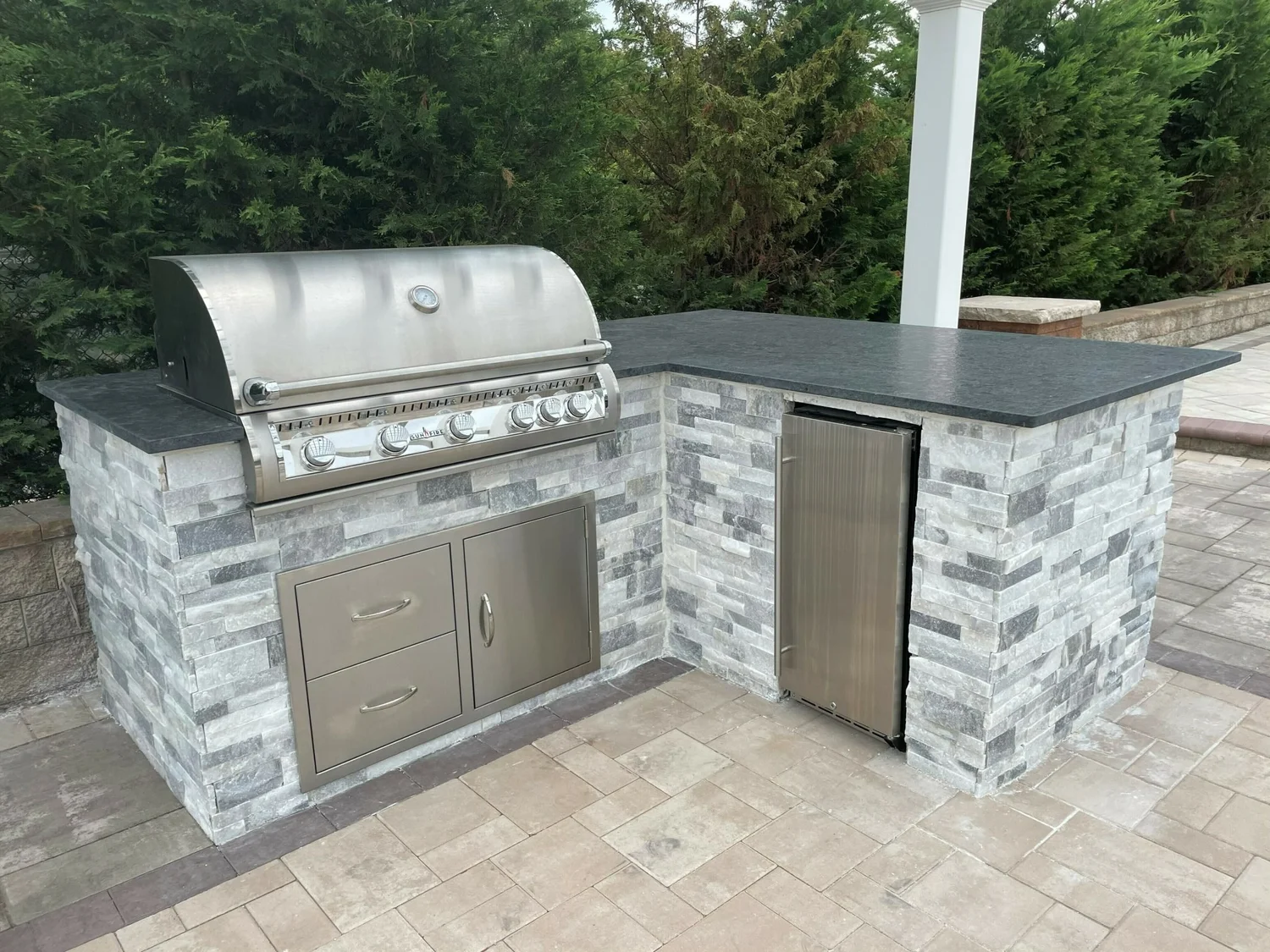
What an Outdoor Living Space Actually Is (Not Just a Grill on a Patio)
A few years ago, an "outdoor kitchen" meant a built-in grill and a stretch of counter. That is not what people are asking us for anymore. The shift in 2026 is toward a full outdoor room, where the cooking, prep, dining, and lounging areas flow into one another the same way they do inside the house.
It helps to separate two terms people use interchangeably. The outdoor kitchen is the cooking unit itself: the island, the grill, the counters, the storage. The outdoor living space is the whole room around it: the kitchen plus a dining area, a lounge anchored by fire, shade overhead, and lighting that lets you use all of it after the sun goes down. A grill island makes you a cook. A living space makes your backyard the place everyone wants to be.
The point of designing the full space up front is simple. You do not want to pour a slab this year, then discover next year that there is no room for a table, or no shade, or nowhere to run the gas line. Plan the whole room first, even if you build it in stages.
It Starts With the Slab (The Part That Decides Everything)
Here is the part most homeowners never think about, and most low-bid contractors hope you never ask about. A masonry kitchen and a stone patio are only as good as what is poured underneath them.
South Jersey lives through freeze and thaw all winter. Water works its way into concrete and the ground beneath it, freezes, expands, and pushes up. A slab that was poured thin, on a base that was not compacted, with no reinforcement, will heave and crack. When that happens under an outdoor kitchen, the damage is not cosmetic. The veneer cracks, the counters pull out of level, and the joints around the grill open up. A forty thousand dollar kitchen built on a bad slab is a forty thousand dollar problem.
Every base we pour, under every kitchen and every patio, is built to the same spec: 4000 PSI concrete, a 6 inch compacted base, steel rebar reinforcement, and fiber mesh. Control joints are pre-planned and sawcut on the grout lines, then caulked and color matched, so the concrete cracks where we tell it to instead of across the middle of your seating area. That is the difference between a job that photographs well on day one and a job that still looks right on year twenty.
Ask any contractor you are talking to exactly how thick the slab will be, what the base prep is, and how it is reinforced. The answer tells you most of what you need to know about how the rest of the project will go.
The Anatomy of an Outdoor Kitchen
Once the base is right, the kitchen itself comes together in layers. Here is what each piece is and roughly what it adds, so you can see where the money goes.
The structure (the body of the kitchen)
The island is usually built from concrete block or steel-stud framing, then finished in real stone veneer, stucco, or tile. Budget roughly $250 to $670 per linear foot for the structure alone, depending on the finish. A ten foot run can land around $4,000 just for the body, before a single appliance goes in. This is the part that has to handle the weather, so it is not the place to cut corners.
Countertops
Granite, porcelain, engineered stone, and poured concrete are the common choices, running about $50 to $200 per square foot installed. In our climate, granite and porcelain are the safe bets because they shrug off freeze and thaw. Light-colored granite also resists fading in full sun. A typical island needs fifteen to twenty square feet of counter.
The grill and appliances
The grill is the centerpiece, and prices spread out fast. A solid mid-range built-in runs $1,500 to $5,000; premium brands climb past $10,000. From there you can add an outdoor-rated refrigerator ($800 to $2,500), a sink with plumbing, storage drawers, and specialty pieces like a pizza oven ($500 to $3,000), a side burner, a smoker, or a beverage cooler.
Our honest advice after forty plus years: spend on the base, the structure, and the counters, because those are forever. Buy the grill you will actually use every week. Do not blow the budget on three gadgets you will fire up twice a summer.
Designing the Whole Space: Zones, Shade, Fire, and Flow
The kitchen is the engine. The living space is the room. A few elements turn one into the other.
Shade and season extension
A pergola or roof structure (roughly $2,200 to $9,000) does two things in New Jersey: it gives you shade in July and it stretches your season into the cool ends of spring and fall. That is real value in a climate where the calendar fights you for half the year.
Fire
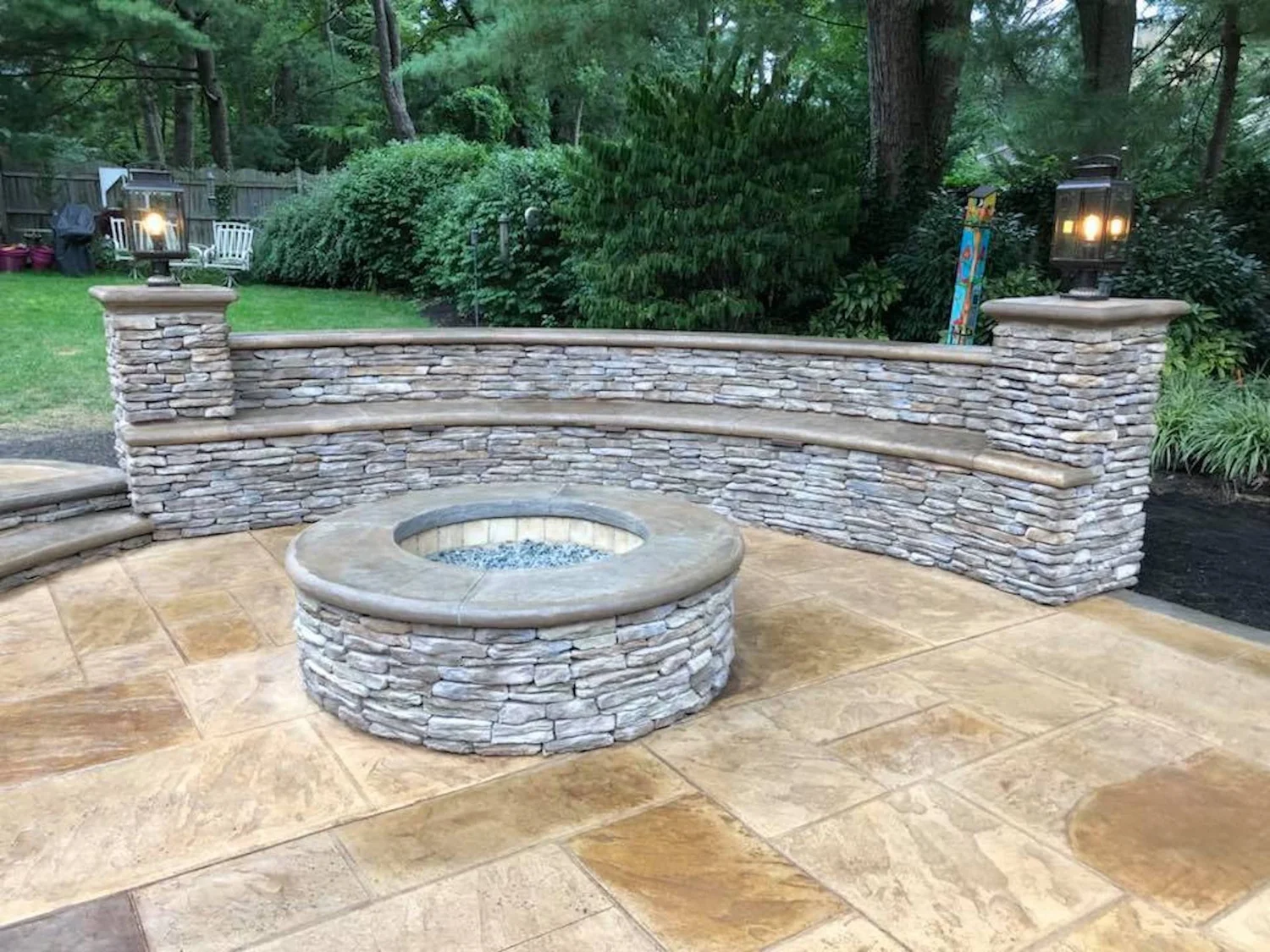
A fireplace or fire feature is what anchors the lounge zone and keeps people outside once the temperature drops. If you are weighing the options, our breakdown of the patio features that actually earn their cost covers fire pits, seating walls, and lighting in detail.
Lighting and flow
Low-voltage lighting (about $2,100 to $4,900) is what makes the whole space usable at night instead of going dark at dusk. And flow matters more than people expect. Keep the cook out of the main traffic path, put the dining table within a few steps of the grill, and orient the lounge toward the fire or the best view in the yard. Sun exposure and the grade of your property drive these decisions, which is why the layout should be designed for your specific yard, not pulled off a template.
Materials That Survive a South Jersey Winter
Freeze and thaw is the enemy of every outdoor surface here, and it is unforgiving of shortcuts. Cheap pavers laid on a thin base shift and settle. Foam-backed faux veneer pops loose. The materials you pick should be chosen for our winters first and looks second, and the good news is you do not have to give up one for the other.
For the hardscape under and around the kitchen, the three real options are stamped concrete, pavers, and natural stone. Stamped concrete gives you one continuous surface with no joints for weeds to grow through and a textured, slip-resistant finish. Pavers cost more and can be lifted and reset in one spot if needed. Natural stone and travertine deliver a premium look at a premium price. We install all three, and if you are deciding between them, our stamped concrete versus pavers comparison lays out the honest trade-offs. For ideas on patterns and color, the stamped concrete patio design guide is a good place to start.
For the kitchen body itself, insist on real stone veneer set over a block or steel structure. For counters, sealed granite or porcelain. Those choices are what keep the space looking built, not bolted together, a decade from now.
What an Outdoor Kitchen Costs in South Jersey (2026)
Be careful with the numbers you find online. The "average outdoor kitchen costs around $13,000" figure you see everywhere usually leaves out the appliances and assumes the kitchen sits right next to the house. A real custom build, with a proper base and the trades done correctly, runs higher than that, and New Jersey labor sits above the national average. Here is an honest breakdown of where most South Jersey projects land.
$5,000 to $10,000
- Built-in grill and stone-veneer island
- Counter space and basic storage
- Poured on a properly reinforced base
- Tapped into nearby existing utilities
$15,000 to $30,000
- Built-in grill, stone counters, refrigerator, and sink
- Generous storage and prep space
- Stamped concrete or paver patio base
- Task and accent lighting
$30,000 to $60,000+
- Kitchen plus dedicated dining and lounge zones
- Pizza oven, fireplace, or fire feature
- Pergola or roof structure for shade and season
- Full hardscape and low-voltage lighting throughout
One cost driver people overlook is where the kitchen sits. If it is close to the house, we can usually tap into your existing gas, water, and electric for roughly $500 to $2,000. Set it farther out in the yard and the utility runs alone can reach $2,000 to $5,000 or more, depending on distance and code.
Why does a premium build cost what it does here? New Jersey labor, licensed trades for the gas and electrical, real materials instead of glue-ons, and a base engineered to outlast the freeze and thaw. You are not only paying for what you see. You are paying for the part that keeps what you see standing. Financing is available through Credit Karma if you would rather spread the investment out.
Permits, Utilities, and Timeline
An outdoor kitchen that involves gas, electric, or plumbing needs permits in New Jersey, handled through your town under the state Uniform Construction Code. We pull what is required and coordinate the licensed trades, so you are not chasing inspectors or project-managing five different contractors. That is part of what you hire a real company to handle.
Timeline depends on scope and weather, but a full outdoor living space is typically a few weeks on site. As for when to build: spring is the busiest season and books up early, so if you want your space ready for this summer, the time to start the conversation is now. Fall is the quiet secret. Concrete cures best in moderate temperatures, the calendar is open, and you walk into next season ready to go.
Is It Worth It? ROI and the Real Reason
Outdoor kitchens consistently rank among the higher-return backyard improvements. Regional real estate figures put the property-value bump somewhere around ten to fifteen percent, and broader ROI estimates run wide depending on the quality of the build and your market. A permanent, built-in kitchen appraises better than a portable setup, and a complete kitchen with a grill, fridge, and real counter space shows far better to a buyer than a lone grill island.
But the honest reason most people build one has nothing to do with resale. It is that you stop looking at your backyard and start living in it. That is the return that actually shows up, every weekend, for years.
Why South Jersey Homeowners Call Patrick Breen
We are a third-generation family business that has been building across South Jersey since 1983: more than forty-three years and over twenty-one hundred completed projects, fully licensed (NJ Lic #13VH00144300) and credentialed through the ACI and ICPI.
What sets us apart on a job like this is that we self-perform the concrete and the masonry. We are not a paver outfit subbing out the parts that matter and marking them up. The slab, the structure, the stonework, the finish, that is our crew. We also coordinate the grill, gas, and electrical so the whole project runs through one company that stands behind all of it.
We build outdoor kitchens and living spaces throughout Gloucester and Camden County, including Mullica Hill, Washington Township, Woolwich, Harrison Township, Mantua, Sewell, Glassboro, Swedesboro, Woodbury, Cherry Hill, Voorhees, Moorestown, Medford, and Haddonfield.
Frequently Asked Questions
How much does an outdoor kitchen cost in South Jersey?
Most projects land between $5,000 for an essential grill station and $60,000 or more for a full outdoor living space. A complete outdoor kitchen with a grill, counters, refrigerator, and a stamped concrete or paver base typically runs $15,000 to $30,000. Where the kitchen sits relative to your utilities is a major cost factor.
How long does it take to build?
A full outdoor living space is usually a few weeks on site, depending on the scope and the weather. We give you a clear schedule before we start.
Can you build an outdoor kitchen on my existing patio?
Sometimes, and sometimes not. It depends entirely on how that patio was built, how thick the slab is, and how it was reinforced. We will evaluate it honestly. If the base will not support the weight or survive the freeze and thaw, we will tell you, because building on a bad foundation only postpones the problem.
Will it crack in the winter?
Not if it is built correctly. Our base spec is 4000 PSI concrete on a 6 inch compacted base with steel rebar and fiber mesh, plus pre-planned control joints that direct any movement away from the surfaces you see. That is exactly what stands up to South Jersey winters.
Should I run natural gas or propane?
Natural gas is the more convenient long-term choice if a line can reach the kitchen, because you never refill a tank. Propane is simpler and cheaper to set up when running a gas line is not practical. We will walk you through which makes sense for your yard.
Do you handle the permits?
Yes. We pull the required permits through your town and coordinate the licensed trades for gas, electric, and plumbing so you do not have to.
What is the best time of year to build?
Spring is the most requested and books up fast. Fall is often the smarter move: concrete cures best in moderate temperatures, scheduling is easier, and you are ready the moment next season opens. To have a space finished for this summer, start the conversation now.
Let's Design Your Outdoor Living Space
See your project come together and get a real number to plan around. Use our project builder to start a design, or call and talk it through with us directly. Estimates are free.
Start Your Design Call or Text 856-223-1100Financing available through Credit Karma. Licensed NJ contractor #13VH00144300.
Built by hand, the way it should be.
Pat Breen Jr.Patrick Breen Masonry & Concrete · Three generations of South Jersey craftsmanship since 1983