
4 Features That Transform a Basic Patio Into an Outdoor Living Space
4 Features That Transform a Basic Patio Into an Outdoor Living Space
A flat slab of stamped concrete is a nice patio. Add the right features and it becomes a room — one that your family actually uses from April through November. Here's what each feature does, what it costs, and whether it's worth the investment based on 40+ years of building these spaces across South Jersey.
In This Article
We've poured thousands of patios in Mullica Hill, Cherry Hill, Voorhees, Washington Township, and everywhere in between. The ones that actually get used — the ones families eat dinner on, host parties on, sit outside with a glass of wine on a Tuesday night — almost always have at least two of these four features. The flat patios without any features? Those tend to collect patio furniture and not much else.
1. Seating Walls

This is the feature that surprises people the most. A seating wall doesn't sound that exciting on paper, but it fundamentally changes how a patio functions. Instead of dragging chairs around or running inside to grab extra seating when people come over, you have permanent, built-in seating that defines the edges of your space.
What it actually does
A seating wall creates structure. It separates your patio from the yard without a fence, gives people a natural place to sit, and creates that "room" feeling that makes a patio feel like a real outdoor living area instead of a concrete slab in the grass. They also serve as a wind buffer on breezy evenings and a convenient surface to set a drink or plate down.
Most of the seating walls we build are 18 to 20 inches tall — standard bench height — with a smooth capstone on top that's comfortable to sit on. The face is finished in Eldorado stacked stone veneer, which gives it a natural stone look without the cost of solid stone construction. We offer 11 stone colors from Nantucket (white and cream tones) to Black River (deep charcoal).
What it costs
Seating walls run roughly $275 per linear foot with stone veneer and cap stones, with most projects starting around $5,000. A typical 16-to-18-foot wall that wraps one or two sides of a patio comes in around $4,500 to $5,500. Add LED capstone lighting underneath and you're looking at an additional $600 to $1,200 depending on how many fixtures.
Our take: If you're spending $15K+ on a patio, a seating wall is one of the best additions for the money. It adds more usable seating than any patio furniture set, it never blows away in a storm, and it looks intentional — like the patio was designed as a complete space, not just a surface.
2. Fire Pits
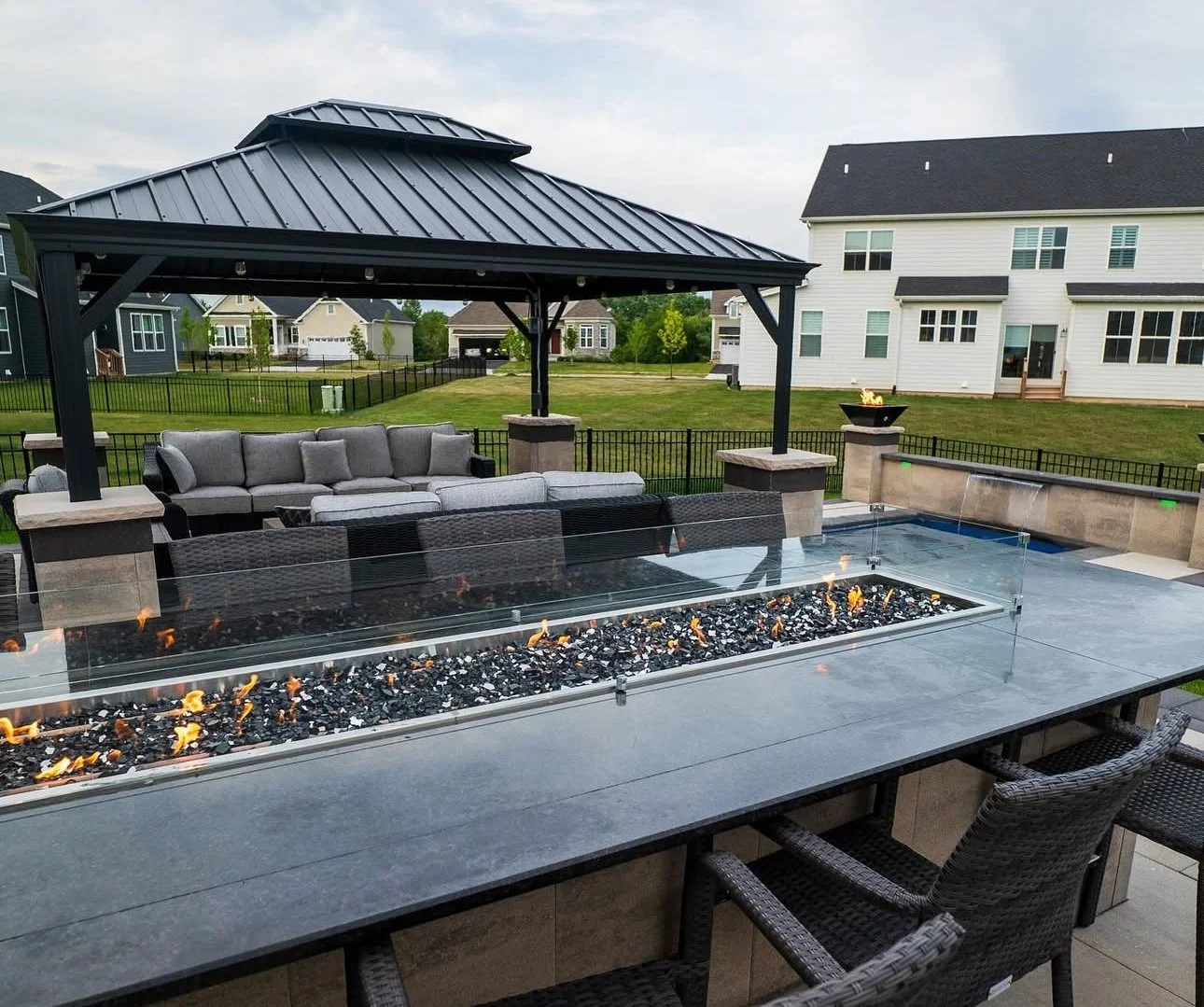
Fire pits are the single most requested add-on we get. And for good reason — they extend your patio season by two months on each end. In South Jersey, a patio without a fire feature is basically usable from May through September. Add a fire pit and you're out there from late March through November.
What it actually does
Beyond the obvious warmth, a fire pit creates a natural gathering point. People orient toward fire. When you have a fire pit on your patio, that's where everyone ends up sitting — it pulls the space together and gives the evening a focal point. It also replaces the need for a portable fire pit that rusts, tips over, and scorches whatever surface it's sitting on.
We build custom fire pits in both wood-burning and gas configurations. Wood-burning is the classic choice — real crackling fire, real smoke smell, lower cost. Gas is cleaner, starts with a switch, and doesn't leave ash. Gas burners range from simple ring burners to high-output models that throw serious heat.
What it costs
Wood-burning fire pits start at $4,000 for a standard round or square design with stone veneer finish matching your patio. Gas fire pits run $6,000 to $8,000+ depending on the burner type, gas line routing, and finish work. Both include the concrete foundation pad, drainage, stone veneer, and cap stones.
Our take: A fire pit is the feature that gets the most use per dollar spent. We hear from customers constantly that it's where they spend every evening once the weather breaks. If you can only add one feature to your patio, this is the one. Go wood-burning if you want the full experience and don't mind managing the fire. Go gas if convenience matters more.
3. LED Landscape Lighting
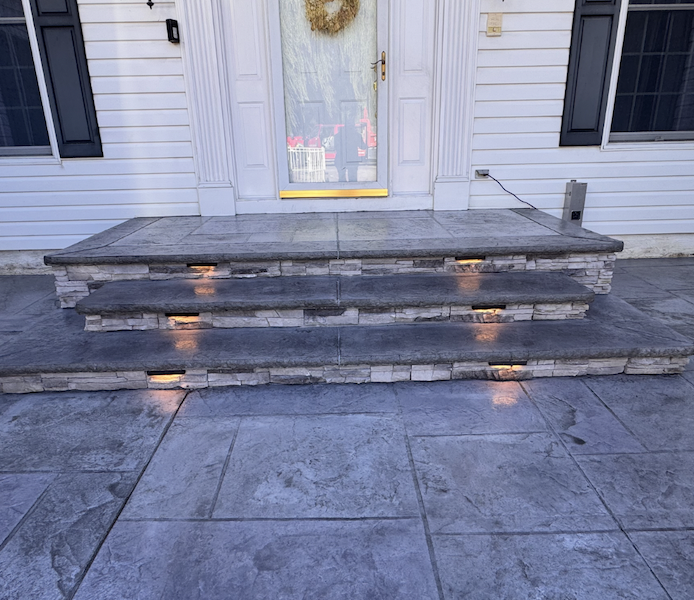
Lighting is the feature people don't think about until they see it. It's also the one that makes the biggest visual difference dollar-for-dollar. A patio without lighting is basically a daytime feature. Once the sun goes down, you're either sitting in the dark or blasting a floodlight from the house that makes your backyard look like a prison yard. Professional LED lighting solves that completely.
What it actually does
Proper landscape lighting does three things. First, it makes your patio usable after dark — not just technically visible, but actually inviting. Low, warm LED light creates ambiance that overhead lights can't match. Second, it highlights the design work you've invested in. That Ashlar Slate stamp pattern and stone veneer seating wall you paid for? Nobody can see them after 8pm without lighting. Third, it adds safety — illuminated steps, walkways, and grade changes prevent trips and falls.
We install TruScape LED systems, which are commercial-grade fixtures specifically designed for hardscape applications. The main types we use are path lights (along walkways and borders, available in Traditional, Modern, and Classic styles), dot lights (small recessed fixtures set into the patio surface or step risers), step lights (under each step riser for safety), hardscape lights (mounted into seating wall caps), and pillar lights (on columns and wall ends).
What it costs
Lighting packages start around $1,350 for a basic setup and go up to $7,500+ for a full system with multiple fixture types. Path lights run about $200 each installed, dot lights about $130 each, and hardscape wall lights about $110 each. A typical patio lighting package with 4 to 6 path lights and 6 to 8 dot lights runs $2,000 to $3,000. All systems include the transformer, wiring, and timer.
Our take: Lighting is the most underrated patio feature. It's relatively affordable compared to the other three features on this list, and it makes everything else look better. If you're building a patio with a fire pit and seating wall, skipping the lighting is like renovating your kitchen and not putting in under-cabinet lights. The investment is small relative to the total project, and the impact at night is dramatic.
4. Pergolas & Overhead Structures

A pergola does something none of the other features can — it defines overhead space. It turns an open patio into something that feels more like a room by giving it a ceiling. That psychological shift is real. Walk from the open part of a patio under a pergola and you feel like you've stepped inside, even though you're still outside.
What it actually does
The primary function is shade and spatial definition, but the specifics depend on which type you go with. We offer several options through our vendor partners at Backyard Discovery and FlexPatio.
Traditional cedar pergolas from the Backyard Discovery Beaumont line give you the classic open-beam look with slatted roof beams that filter sunlight. They don't block rain, but they provide partial shade and a strong visual anchor. Sizes range from 10x10 to 24x12, starting around $1,400.
Steel louvered pergolas from the Sarasota and Evanston lines have adjustable metal louvers — you can angle them open for sun, close them for full shade or rain protection. This is the best middle ground between a traditional pergola and a full roof. Freestanding models start around $2,000, wall-mounted versions from $1,900.
Full cedar gazebos with steel roofs from the Norwood, Barrington, and Arcadia collections provide complete weather protection — rain, snow, full sun. These are permanent structures with real roofing. Sizes from 10x10 to 24x12, starting at $1,899 for the Arcadia line up to $5,299 for the largest models. Built-in electrical outlets and USB ports come standard on most models.
Motorized aluminum pergolas from FlexPatio are the premium option. The POWER+ system gives you remote-controlled adjustable louvers, built-in LED lighting, integrated power outlets, and optional add-ons like sliding glass doors, motorized roller shades, and privacy shutter walls. It's aircraft-grade aluminum rated for 120 MPH winds. Sizes from 10x10 ($5,000) to 13x20 ($10,000).
What it costs
The range is wide because the options are wide. A basic cedar pergola is $1,400 to $3,000 depending on size. A steel louvered pergola runs $2,000 to $3,500. A full gazebo with roof is $1,900 to $5,300. And a FlexPatio motorized setup runs $5,000 to $10,000+ before add-ons like glass doors and shades. All of these are product costs — installation, shipping, and the concrete pad or footer work are additional.
Our take: A pergola is the biggest visual statement you can make on a patio. It also has the widest price range, so it's worth thinking carefully about what you actually need. If you want shade and ambiance, a traditional cedar pergola does the job for under $2K. If you want real weather protection to use the space year-round, a gazebo or the FlexPatio POWER+ with side enclosures is the move. If you're building an outdoor kitchen, an overhead structure is almost a necessity — you want shade over the cooking area.
How They Work Together
These four features aren't just individual add-ons — they compound. A seating wall around a fire pit with LED capstone lighting underneath and a pergola overhead is a completely different experience than any one of those features alone. It's the difference between "we have a patio" and "we live outside."
The projects where customers get the most out of their investment are the ones where at least two or three features are designed together from the start. The seating wall gets positioned to face the fire pit at the right distance. The lighting is planned to highlight the stone veneer and cast warm pools of light where people sit. The pergola is sized and positioned to cover the main seating zone. Everything feels intentional because it was planned as one project, not bolted on as afterthoughts.
That said, you don't have to do everything at once. We design plenty of patios where the base patio and fire pit go in year one, and the seating wall and pergola come year two. As long as the layout accounts for future features from the beginning — proper footers, electrical conduit run in advance, pad sized for the eventual pergola posts — phasing works fine.
Where to Start
If you're trying to figure out what your patio would look like with these features — and what it would cost — we built a tool for exactly that. Our interactive project builder lets you choose your patio surface, add a fire pit, seating wall, lighting, pergola, outdoor kitchen, and more. It gives you a ballpark estimate and generates an AI visualization showing what it could all look like in your yard.
Or skip the tool and just call us. We do free in-person consultations where we measure your space, talk through your ideas, and hand-design a 3D mockup of your project — included at no charge with your estimate. We've been doing this in South Jersey since 1983 and we're happy to give you an honest assessment of what's worth building and what's not for your specific space.
Ready to Design Your Outdoor Space?
Try our free interactive project builder or call for a consultation.
Build Your Project →Mullica Hill · Cherry Hill · Washington Township · Voorhees · Haddonfield · Mt. Laurel · Deptford · Sewell · Marlton · Moorestown
Patrick Breen Masonry & Concrete · Mullica Hill, NJ · NJ Lic #13VH00144300 · All Service Areas →