
Complete Backyard Transformation: What It Costs, What's Included, and How We Build It
Complete Backyard Transformation: What It Costs, What's Included, and How We Build It
The full breakdown of turning a bare backyard into an outdoor living space — from one South Jersey contractor who handles every piece.
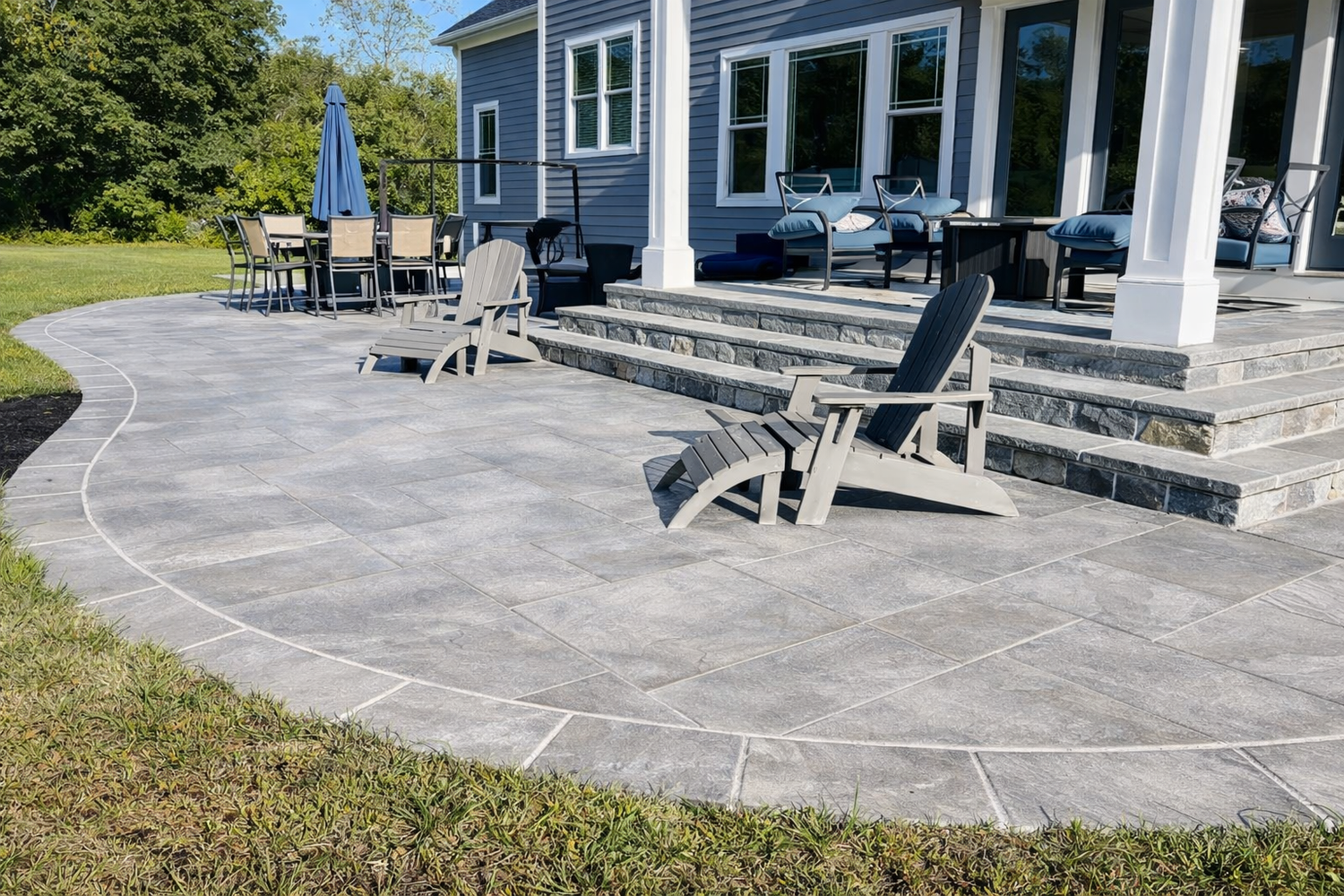
Complete backyard transformation — stamped concrete patio, outdoor kitchen, fire pit, seating walls, and landscape lighting
A stamped concrete patio is a great start. But the backyards that make your neighbors stop and stare — the ones that feel like an extension of your house rather than just a slab behind it — are built as complete outdoor living spaces. Patio, walkway, steps, seating walls, fire pit, outdoor kitchen, lighting, curbing, and landscaping transitions all designed together and built by one crew.
We've been building complete backyard transformations across South Jersey since 1983. Not just the concrete — everything. The kitchen island, the fire pit, the Tru-Scapes lighting, the Belgard curbing, the stone veneer on the house foundation, the walkway connecting the driveway to the patio. One contractor, one crew, one cohesive design. Here's exactly what goes into a project like this, what it costs, and how the process works from first phone call to final walkthrough.
What a Complete Backyard Transformation Includes
Every backyard is different, but a full transformation typically combines five to eight elements into a single build. The beauty of doing it all at once is that everything is designed to work together — the patio pattern flows into the walkway, the seating wall matches the kitchen island veneer, the lighting is wired before the concrete is poured, and the curbing creates clean transitions to landscaping. None of that happens when you hire three different contractors over three different years.
The Patio
The patio is the foundation of everything. It's the largest surface, the gathering area, and the design anchor. Most full backyard transformations in South Jersey start with a 400–600 square foot stamped concrete patio. That's enough room for a dining table, a lounge area, and a fire pit or kitchen — without feeling cramped.
We pour stamped concrete in patterns like ashlar slate, random flagstone, wood plank, and cobblestone. Integral color goes throughout the entire slab, with a contrast release color that settles into the joints and texture to create depth. The pattern and color choices set the tone for the entire project — everything else matches or complements the patio.
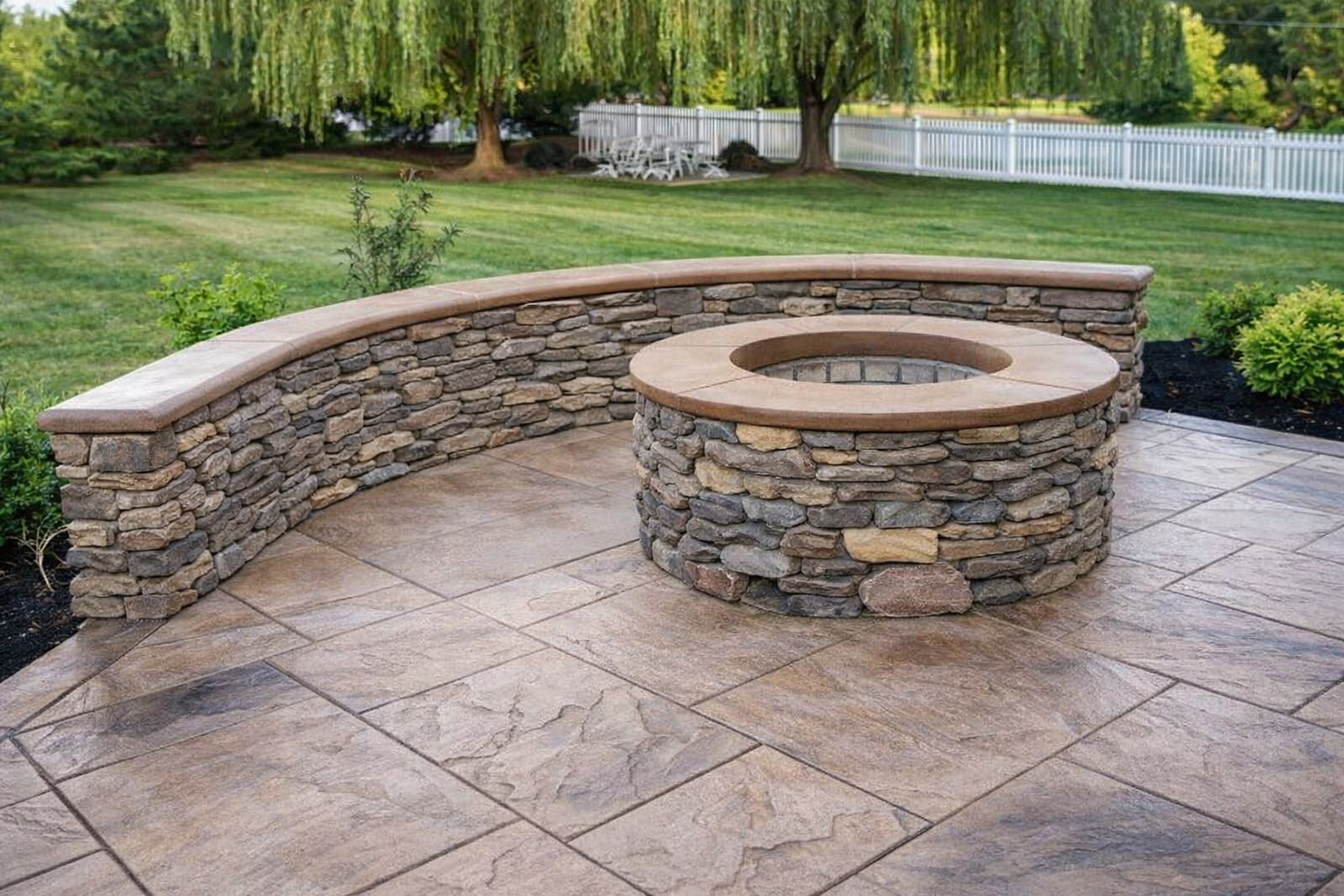
Stamped concrete patio with built-in fire pit — Washington Township, NJ
Walkways and Steps
A great patio connected to your house by a cracked sidewalk or a muddy path through the grass defeats the purpose. Complete transformations include stamped concrete walkways that connect the back door to the patio, the patio to the pool (if you have one), and sometimes a front walkway to the driveway for full curb appeal.
Steps get the same treatment. We pour stamped concrete risers with bullnose edges, optional Trex composite caps on the treads, and Tru-Scapes riser lights built into every set. Steps aren't an afterthought — they're a design feature. Matching the step pattern to the patio creates a seamless flow from the house down to the outdoor living area.
Seating Walls
Seating walls define spaces without blocking views. A 24-inch high wall along the patio perimeter creates built-in seating for 8–12 people without a single chair. We build them with a concrete block core, finish them with stone veneer or stamped concrete to match the patio, and cap them with natural bluestone, limestone, or concrete caps.
Seating walls also serve as a mounting surface for Tru-Scapes hardscape lights — the low-profile LED fixtures mount underneath the cap and cast a warm downward glow onto the patio surface. It's the single most impactful lighting detail in any outdoor living project.
Fire Pit or Outdoor Fireplace
Every backyard transformation needs a fire feature. It's the anchor — the thing that draws people outside in April and keeps them out there into November. We build both wood-burning and gas fire pits, plus full outdoor fireplaces with mantles and stone veneer surrounds.
A built-in fire pit typically sits at the center or edge of the patio with the seating wall wrapping around it. Gas fire pits run on a dedicated gas line (we coordinate with a licensed plumber) and ignite with a switch — no wood, no ash, no smoke complaints from the neighbors. Wood-burning pits are more traditional and less expensive to build but require more clearance and maintenance.
Outdoor Kitchen

Custom outdoor kitchen island with stone veneer, built-in grill, and bar seating
This is where a patio becomes a living space. An outdoor kitchen island gives you a grill, counter space, storage, and a bar — all built into a permanent stone veneer structure that matches the rest of the project. We build custom islands with concrete countertops, cutouts for built-in grills, pizza ovens, sinks, refrigerators, and trash pullouts.
The island structure is built with steel stud framing and concrete backer board, wrapped in Eldorado or natural stone veneer, and topped with poured concrete or granite countertops. Gas and electric are run during the framing stage by licensed trades we coordinate directly — you don't have to hire your own plumber or electrician.
For homeowners who want a turnkey option, we also install the Lancaster outdoor kitchen line by Backyard Discovery — prefabricated modular units in Linear, L-Shape, and Galley configurations that arrive ready to finish with your choice of veneer and countertop. These are a great option for homeowners who want a high-end outdoor kitchen without the custom build timeline.
Landscape Lighting
Lighting is what makes an outdoor living space usable after dark — and it's the detail that most contractors skip or subcontract out. We install Tru-Scapes low-voltage LED systems as part of every full transformation. The wiring runs under the base and through the walls during construction, so there are no exposed conduits or retrofit headaches.
A typical lighting package for a full backyard transformation includes hardscape lights under seating wall caps, path lights along walkways, step riser lights on every set of stairs, uplights on trees and the house facade, and pillar lights on any columns or kitchen island corners. The entire system runs on a 12V transformer, costs pennies per night to operate, and is controlled from your phone via Bluetooth.
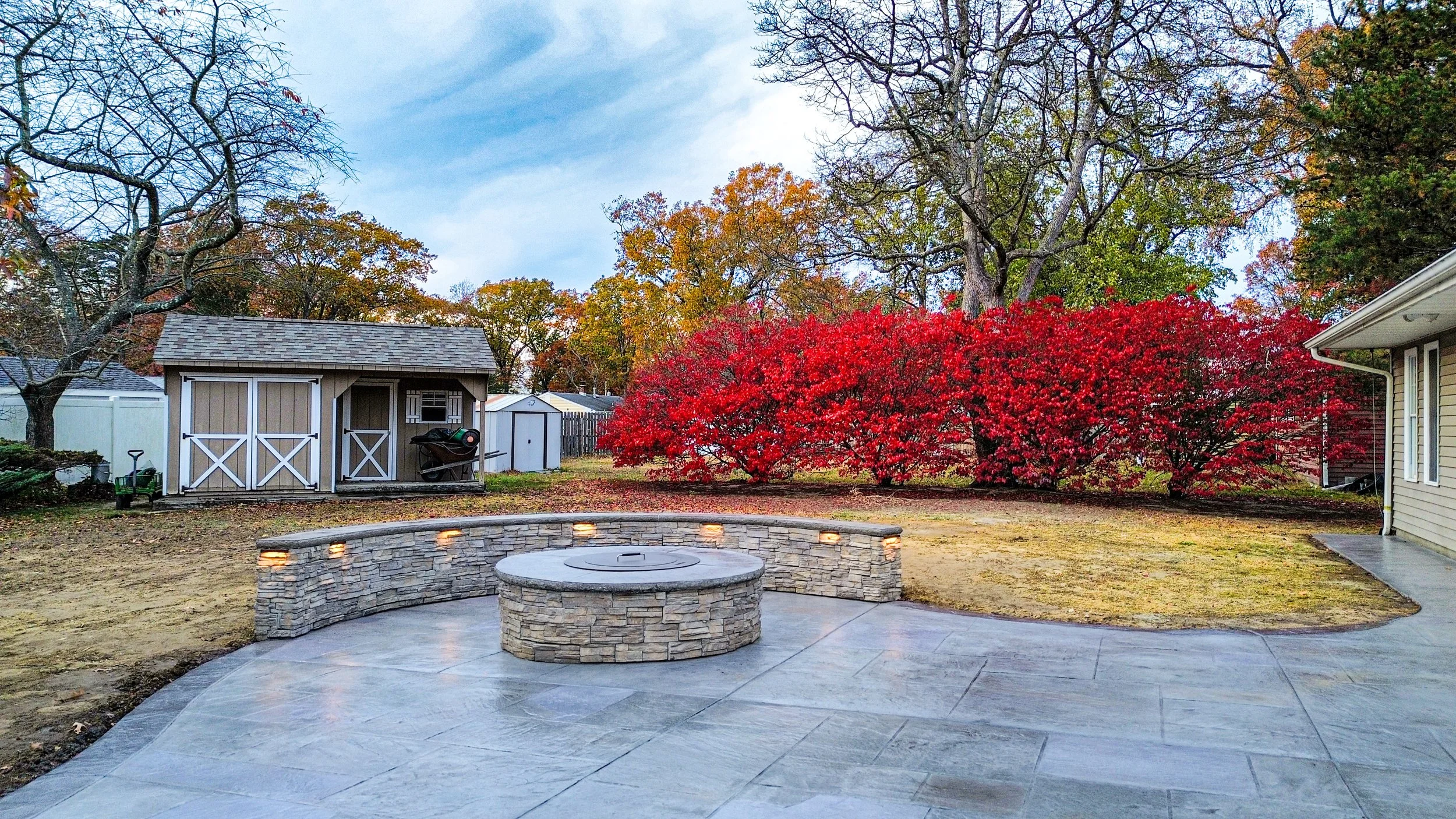
Tru-Scapes LED lighting on a completed backyard transformation — drone photo at dusk
Curbing and Landscape Transitions
Belgard Curbstones create the clean edge between hardscape and landscape that makes the entire project look intentional. Without curbing, mulch washes onto the patio, grass creeps into the concrete edge, and the lawnmower chips away at the border every week. Curb stones solve all of that and add a finished, architectural detail that ties everything together.
We install curbing during the grading phase — before the concrete is poured — so it's level, integrated, and permanent. It's one of those details that costs relatively little but makes a massive visual difference.
Pergolas and Shade Structures
For homeowners who want shade over the dining area or kitchen, we build pergola structures in wood, vinyl, or aluminum. We also install the FlexPatio POWER+ motorized aluminum pergola with adjustable louvers and integrated LED lighting — a premium option that provides rain protection and shade control at the push of a button.
Pergola footings are poured as part of the patio base work, so the structure is anchored into the same foundation as everything else. No wobbly post-mounted shade sails or freestanding gazebos that blow over in a storm.
What a Complete Backyard Transformation Costs in South Jersey
This is the question everyone wants answered, and we're going to give you real numbers — not "call for a quote" runarounds. Every project is different based on size, features, and site conditions, but here's what South Jersey homeowners typically invest in 2026:
| Project Scope | Typical Investment |
|---|---|
| Patio only (400 sq ft stamped concrete) | $7,000 – $10,000 |
| Patio + walkway + steps | $12,000 – $18,000 |
| Patio + walkway + steps + fire pit + seating wall | $18,000 – $28,000 |
| Full transformation (patio + kitchen + fire pit + walls + lighting + walkway + steps + curbing) | $30,000 – $55,000 |
| Premium transformation (all above + pergola + water feature + pool deck integration) | $50,000 – $80,000+ |
These ranges include demolition of existing surfaces, grading, base prep, all materials, labor, and sealing. They do not include landscaping plants, furniture, or appliances (grills, refrigerators) — though we can coordinate appliance ordering and installation as part of the build.
Why doing it all at once saves money: Building a patio this year, adding a fire pit next year, then a kitchen the year after costs 30–40% more than doing it all in one project. Every time we mobilize equipment, set up, pour, and clean up is a separate cost. Grading and base prep done once for the entire area is dramatically more efficient than grading three times for three separate builds. Lighting wired during construction costs a fraction of retrofitting it after. And the design is cohesive — no awkward seams between phases.
How We Build It: The Process From Start to Finish
Phase 1: Consultation and Design (Week 1)
We come to your property, walk the space, take measurements, and talk about how you want to use it. Do you entertain? How many people? Do you cook outside? Do you want a fire pit you can sit around on a Tuesday night or a full kitchen for summer parties? Do you have a pool that needs to be integrated? What's the view from the house — what do you want to see when you look out the back door?
We bring physical stamp samples and color charts so you can see and touch the actual materials on your property, in your light. We also walk you through our interactive project builder where you can select patterns, colors, and features to get a ballpark estimate and an AI-powered visualization of what it could look like.
After the consultation, you get a detailed written estimate with every feature, material, and dimension specified. No vague line items, no allowances, no "we'll figure it out on site." The price you agree to is the price you pay.
Phase 2: Site Prep and Base Work (Days 1–3)
This is where most contractors cut corners — and where problems show up two years later. We demolish and remove existing surfaces, excavate to the correct depth, install and compact a crushed stone base in lifts, set curbing, run lighting conduit and gas lines under the base, and install steel forms to exact grade with proper drainage pitch away from the house.
The base is the most important part of any concrete project. A bad base means cracking, settling, and drainage problems that no amount of beautiful stamping can fix. We don't skip this step and we don't rush it.
Phase 3: The Pour (Days 3–5)
Concrete is ordered to spec — 4,000 PSI air-entrained mix for South Jersey's freeze-thaw cycles. The pour, color application, stamping, and detail work all happen in a single coordinated day for each section. Our crew handles the finishing — broadcasting color hardener, applying release agent, pressing stamp mats, cutting control joints, and hand-tooling borders and transitions.
Large projects may require multiple pours over several days, with each section carefully planned so that joints fall in natural transition points rather than across the middle of a visible area.
Phase 4: Feature Construction (Days 5–10)
After the patio cures, we build the vertical features — seating walls, kitchen islands, fire pit structures, columns, and pillar bases. Steel stud framing goes up, concrete backer board is applied, stone veneer is installed, and countertops are poured or set. Gas and electric trades come in during this phase to run lines and make connections.
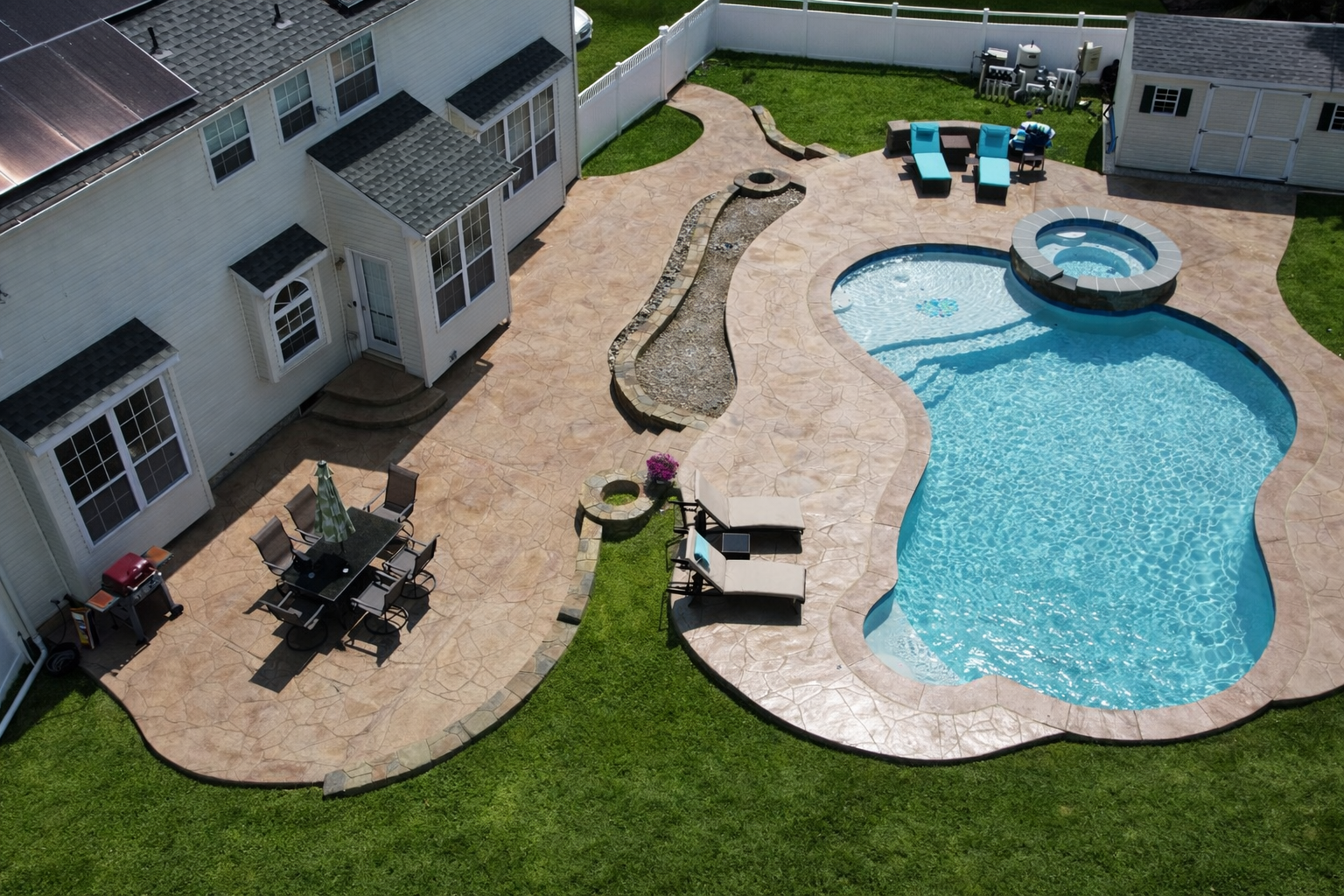
Pool deck and patio integration with seating walls — Cherry Hill, NJ
Phase 5: Finishing and Lighting (Days 10–14)
Lighting fixtures are installed and aimed. Sealer is applied to all concrete surfaces — two coats with 00 sand broadcast for slip resistance. Cap stones are set on walls. Countertops are finished. Curbing joints are sealed. Every detail is checked, every surface is cleaned, and the entire site is cleared of construction debris.
We do a final walkthrough with you to make sure everything meets your expectations — down to the last fixture and joint. Most complete transformations are finished in two to three weeks from the first day of demolition to the final walkthrough.
Phasing: When Budget Doesn't Allow Everything at Once
Not everyone can do $40,000 in one shot, and that's fine. The key to phasing is planning the entire project upfront and building each phase so the next one plugs in seamlessly.
Phase 1 (Spring Year 1): Patio, walkway, steps, and curbing. This is the foundation. Grade and pour everything, run conduit for future lighting even if you don't install fixtures yet, and pour footings for a future pergola or kitchen island even if you're not building them this year. Typical cost: $15,000–$22,000.
Phase 2 (Fall Year 1 or Spring Year 2): Fire pit and seating walls. These are standalone features that can be added after the patio cures without disturbing the existing surface. Typical cost: $5,000–$10,000.
Phase 3 (Year 2): Outdoor kitchen and lighting. The kitchen island is built on the patio surface, veneered, and topped. Lighting fixtures go into the pre-run conduit from Phase 1 — no cutting or trenching required. Typical cost: $10,000–$20,000.
When we design Phase 1, we plan for all three phases. That means the conduit is already in the ground, the footings are already poured, and the patio shape accounts for where the kitchen and fire pit will go. When Phase 2 and 3 happen, they plug right in without any rework.
The mistake to avoid: Building a patio without planning for future features. If you pour a 400 sq ft rectangle and then decide you want a kitchen next year, we may need to cut into the existing concrete, re-grade, and patch — which costs more and never looks as clean. Even if you're phasing, plan the whole project first.
Why One Contractor Matters
Most homeowners who build outdoor living spaces piece the project together: a concrete contractor for the patio, a landscaper for the kitchen island, an electrician for lighting, and maybe a handyman for the fire pit. Here's what happens:
The concrete guy pours the patio but doesn't know where the kitchen gas line needs to come through, so it has to be trenched after the fact. The landscaper builds the kitchen island on top of the patio without anchoring it, so it shifts over winter. The electrician runs exposed conduit because the lighting wasn't planned during the pour. The fire pit doesn't match the patio because three different contractors chose three different materials. And nobody is responsible for the overall design — it looks like what it is: three separate projects built by three separate people at three different times.
When one contractor handles everything — concrete, masonry, stone, features, and lighting — the result is a cohesive space that looks like it was designed by an architect and built by a single skilled team. Because it was.
What Sets Our Work Apart
We build the foundation, not just the features. Unlike landscape contractors who build outdoor kitchens on top of whatever surface already exists, we pour the patio, build the walls, construct the kitchen, install the lighting, and set the curbing. We control every layer from the compacted base to the final sealer coat.
Our own crew, every project. We never subcontract our concrete or masonry work. The same experienced team that pours your patio builds your kitchen island and sets your seating wall caps. That's how we maintain quality across every element — and it's why the veneer on your kitchen matches the veneer on your fire pit perfectly.
We know South Jersey's conditions. Every outdoor living feature we build is engineered for this area's freeze-thaw cycles, sandy-clay soil mix, and drainage patterns. We've been working in Gloucester, Camden, Burlington, and Atlantic counties for 43 years. We know which neighborhoods have high water tables, which developments have HOA restrictions, and which townships require permits for fire pits.
43 years, 2,167+ projects, 4.9-star Google rating. Three generations of the Breen family have built this business on doing the work right. We're not a franchise, not a marketing company with subcontractors, and not a startup learning on your backyard. We're a family that's been pouring concrete and laying stone since 1983.
Is a Complete Transformation Worth It?
The short answer: if you're going to do it eventually, do it now. A complete backyard transformation adds $20,000–$50,000 in usable value to your home — and unlike a kitchen remodel that you only see when you're cooking, you use an outdoor living space every single day from April through November. It's where you eat dinner on a Wednesday, watch the game on Saturday, host your kid's birthday party, and sit around the fire with your neighbors on a fall evening.
Every real estate agent in South Jersey will tell you the same thing: homes with finished outdoor living spaces sell faster and for more money than homes with bare backyards. A complete transformation isn't just a lifestyle upgrade — it's an investment in your property.
Ready to Transform Your Backyard?
Patrick Breen Masonry & Concrete builds complete outdoor living spaces across South Jersey — patio, walkway, steps, kitchen, fire pit, seating walls, lighting, and curbing, all designed and built by one crew. Free on-site consultations with real pricing, real samples, and no pressure.
Schedule Your Free Design Consultation →
Or design your project online with our Interactive Project Builder — pick your features, see pricing estimates, and get an AI-powered visualization of your backyard.
Patrick Breen Masonry & Concrete — Mullica Hill, NJ — Three Generations Since 1983 — NJ Lic #13VH00144300