
Stamped Concrete Cost in South Jersey: Your 2026 Guide
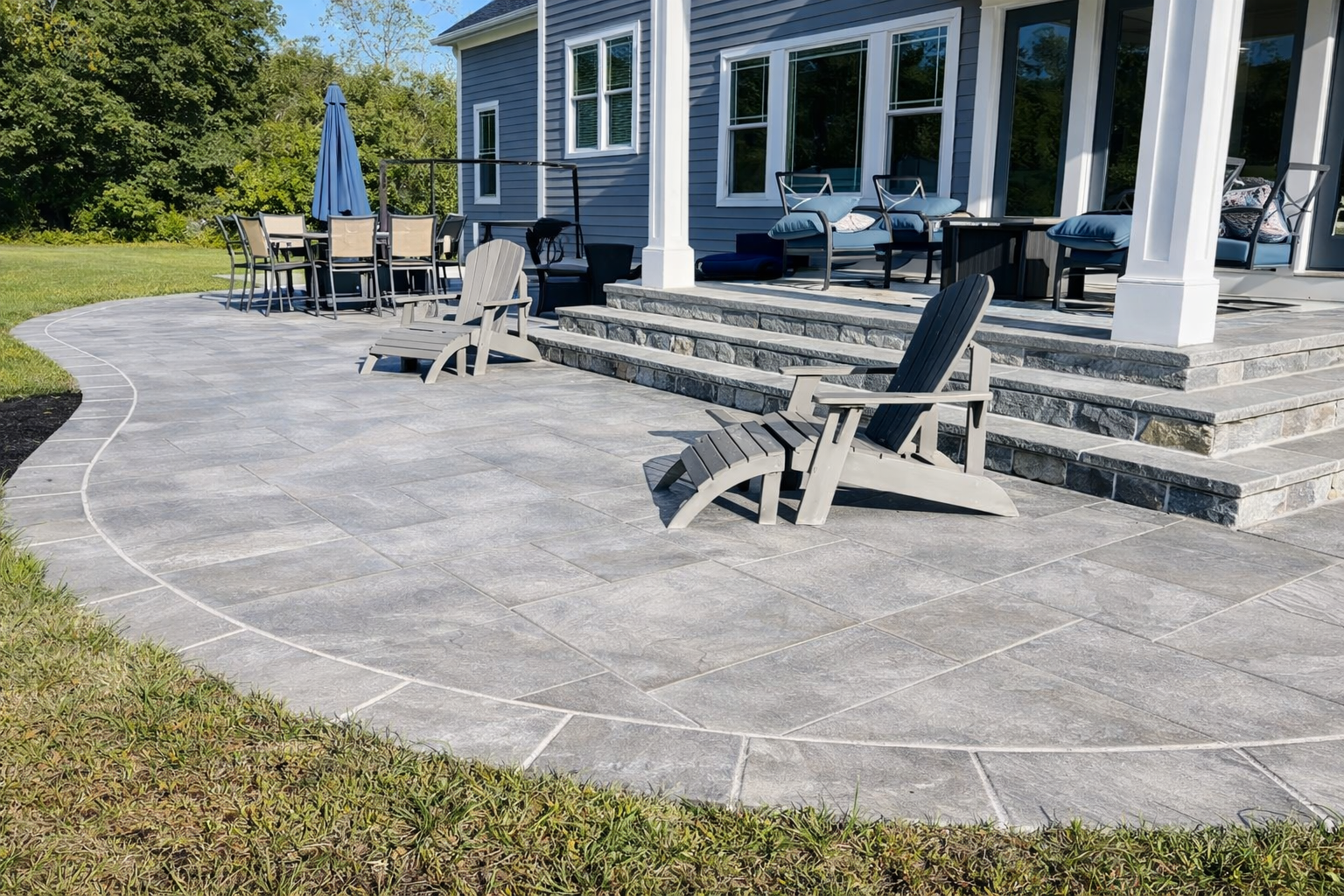
Stamped Concrete Patio - Mullica Hill New Jersey - Large Ashlar Slate
How Much Does a Stamped Concrete Patio Cost in South Jersey? (2026 Pricing Guide)
If you're planning a stamped concrete patio in South Jersey, you want real numbers — not vague national averages that don't reflect what contractors actually charge in Gloucester, Camden, or Burlington County. After completing over 2,167 projects since 1983, we're pulling back the curtain on exactly what stamped concrete patios cost in our area, what drives the price up or down, and how to get the most value out of your investment.
What Does Stamped Concrete Cost Per Square Foot in South Jersey?
Our pricing includes everything — excavation, base preparation, forming, concrete, color, stamping, and sealer application. If your backyard is just dirt, grass, or stone, all of that excavation and grading is already included in the per-square-foot price. Here's how it breaks down by pattern and complexity:
Project Level Price Per Sq Ft What's Included Seamless Texture $17 – $18 Seamless stamp (no grout lines), one base color, one release color, excavation, base prep, sealer Ashlar Slate / Patterned $20 – $22 Patterned stamp, integral color + color hardener, accent release, excavation, base prep, sealer Premium / Multi-Pattern $23 – $25+ Multiple patterns (field + border), custom color blends, hand-applied antiquing, premium sealer
The $20 end of Ashlar Slate is for straightforward installs where we're excavating dirt or stone. If existing concrete needs to be broken out or pavers need to be removed, that pushes it to the $21–$22 range to cover the additional demolition and haul-away. On larger projects (500+ square feet), we can often keep the price tighter even with demo work because the fixed costs are spread over more area.
These are real 2026 numbers based on projects we complete across South Jersey — not national estimates pulled from a database.
How Does That Compare to National Averages?
Most national cost guides quote $9 to $16 per square foot for stamped concrete. That range is misleading for South Jersey homeowners for a few reasons. Labor costs in the Northeast are higher than the national average. Our freeze-thaw climate requires air-entrained concrete mixes, thicker slabs, and more robust base preparation than warmer regions. And material costs — particularly for concrete, crushed stone, and color hardener — reflect Mid-Atlantic pricing, not Midwest or Southern rates.
When you see "$9 per square foot" online, that typically reflects a basic one-color stamp on a simple rectangle in a low-cost-of-living area with no demolition, no grading challenges, and minimal base prep. That's not the reality for most South Jersey backyards.
What Does a Typical Stamped Concrete Patio Actually Cost?
Here's what South Jersey homeowners are actually paying for complete patio projects in 2026:
Patio Size Seamless Texture Ashlar Slate / Patterned Premium / Multi-Pattern Small (200 sq ft) $3,400 – $3,600 $4,000 – $4,400 $4,600 – $5,000+ Average (350 sq ft) $5,950 – $6,300 $7,000 – $7,700 $8,050 – $8,750+ Large (500 sq ft) $8,500 – $9,000 $10,000 – $11,000 $11,500 – $12,500+ Entertainer (700+ sq ft) $11,900 – $12,600 $14,000 – $15,400 $16,100 – $17,500+
These ranges include excavation, base preparation, forming, pouring, coloring, stamping, and initial sealer application. If existing concrete or pavers need to be removed, expect the higher end of each range.
What Factors Affect Stamped Concrete Patio Cost?
1. Size and Shape
Larger patios cost more in total but typically less per square foot. A 200-square-foot patio will run higher per square foot than a 700-square-foot patio because the concrete truck is already there, the crew is already set up, and the fixed costs of mobilization get spread across more square footage.
Irregular shapes — curves, angles, cutouts around landscaping or AC units — add to the cost because they require more forming work and generate more material waste from cutting stamps at the edges.
2. Pattern and Color Complexity
A seamless texture with one integral color is the most affordable option at $17–$18 per square foot. Moving up to a patterned stamp like Ashlar Slate brings the price to around $20–$22 per square foot. Adding a contrasting border pattern, a second accent color, or hand-applied antiquing pushes into the $23–$25+ range.
Our most popular option is Ashlar Slate — it's the sweet spot of visual impact and value. Check out our pattern and color chart to see all available options.
Specific cost impacts of design upgrades:
Adding a contrasting border pattern: +$2–$4 per square foot on the border area
Color hardener upgrade over integral color alone: Depends on style
Hand-applied antiquing or staining: +$2–$3 per square foot
Custom scoring or saw-cut designs: +$1–$3 per linear foot
Build Your Dream Project
Design your perfect outdoor space step by step. Choose your style, materials, colors, and features.
Patrick Breen Masonry & Concrete — South Jersey since 1983
(856) 223-1100 · Mullica Hill, NJ
3. Existing Surface Conditions
If we're working on a clean site — just dirt — excavation is included in our standard per-square-foot pricing. If there's existing concrete that needs to be broken out and hauled away, or pavers that need to be pulled up, that moves the price to the higher end of the range (about $3–$4 more per square foot). Old wood deck demolition can add $3–$6 per square foot depending on the height and complexity of the structure.
4. Access and Logistics
Can a concrete truck back up close to the pour area, or does the crew need to wheelbarrow material 100 feet through a side yard gate? Difficult access adds labor time and cost. Tight backyards, steep slopes, or work areas only accessible through the house (rare, but it happens) all increase the price.
5. Base Conditions
South Jersey sits on a mix of sandy soils near the coast and heavy clay soils inland — particularly in areas like Mullica Hill, Washington Township, and Williamstown. Clay soil requires more extensive base preparation because it holds water and heaves during freeze-thaw cycles. Sandy soil drains well but may need additional compaction. A proper base typically includes 4–6 inches of compacted crushed stone (we use 6 inches minimum), and in clay-heavy areas, we add geotextile fabric between the native soil and stone base.
6. Add-On Features
Most patios aren't just a flat slab. Here's what common add-ons cost:
Stamped concrete steps: $150–$300 per step (includes forming, pour, stamp, and color)
Seat wall / knee wall: $80–$120 per linear foot
Fire pit pad (for a portable or Breeo-style pit): $800–$1,500
Built-in fire pit with stone veneer: $3,500–$6,500
Retaining wall (3 ft height, stucco finish): Starting at $200 per linear foot; with stone veneer finish, expect $300–$325+ per linear foot
Hardscape lighting: $100–$200 per fixture installed with transformer.
Retaining walls are a significant investment — a 30-linear-foot wall at 3 feet tall with stone veneer can run $9,000–$10,000. But if your yard has a grade change, a properly built retaining wall is essential for a level patio surface and proper drainage. Read more in our retaining wall guide.
Stamped Concrete vs. Other Patio Materials: Cost Comparison
How does stamped concrete stack up against the alternatives? Here's a side-by-side based on real South Jersey pricing:
Material Cost Per Sq Ft (Installed) Maintenance Expected Lifespan Plain broom-finish concrete $10 – $14 Low — occasional cleaning 25–30 years Stamped concrete $17 – $30 Low — reseal every 2–3 years 25–30+ years Concrete pavers (Techo-Bloc, Belgard) $28 – $45 Medium — joint sand, weed control, resetting 25–50 years Natural flagstone $30 – $50+ High — joint repair, shifting stones, weeds 30+ years Composite decking (Trex) $60+ Low — occasional cleaning 25–30 years
Stamped concrete consistently delivers the best value when you want a decorative, high-end appearance without the premium price tag. It costs 30–50% less than pavers for a comparable look, requires less ongoing maintenance, and doesn't have the weed-between-the-joints problem that plagues paver installations. Read our full breakdown in Stamped Concrete vs. Pavers: An Honest Comparison.
How to Save Money on Your Stamped Concrete Patio
Book in the Off-Season
Our busiest months are April through July. If your project timeline is flexible, scheduling for late fall or early spring can sometimes mean better availability and scheduling priority. Concrete can be poured in temperatures as low as 40°F with proper precautions.
Choose Seamless Over Patterned
A seamless texture at $17–$18 per square foot still looks great and gives you a decorative surface at the lowest stamped concrete price point. On a 400-square-foot patio, choosing seamless over Ashlar Slate saves you roughly $1,200–$1,600.
Combine Projects
If you're planning a patio now and a walkway next year, do them together. You'll save on mobilization costs, and the crew is already on-site with materials and equipment. Combining a patio + walkway + steps into one project typically saves 10–15% compared to doing them separately.
Phase Your Project
If your dream patio includes a fire pit, seat walls, and outdoor kitchen but the budget isn't there yet, pour the patio slab first with the future features in mind. We can plan the layout, drainage, and reinforcement for future phases so everything connects seamlessly later.
Why Pricing Varies Between Contractors
You'll get different quotes from different contractors. Here's what typically explains the spread:
Low-ball quotes ($12–$15/sq ft) often mean corners are being cut somewhere — thinner slab (4 inches instead of 5–6), inadequate base preparation, no fiber reinforcement, cheap sealer, or an inexperienced crew that stamps too fast and leaves pattern misalignment. You might also see no warranty, no insurance, or a crew that disappears if something goes wrong.
Proper quotes ($17–$22/sq ft) reflect real installation standards: full excavation and base prep, 5+ inch slab, fiber mesh or rebar reinforcement, quality color products, experienced stamping crew, and a workmanship warranty.
Premium quotes ($23–$28/sq ft) include everything above plus custom multi-pattern design elements, premium color application methods, high-end sealers, and often a longer warranty backed by an established company with decades of local reputation.
The cheapest quote is rarely the best value. A poorly installed stamped concrete patio that cracks in two years costs far more than doing it right the first time. Read our guide on How to Choose a Concrete Contractor in South Jersey for what to look for.
What's the ROI on a Stamped Concrete Patio?
According to the National Association of Realtors' Remodeling Impact Report, outdoor living projects consistently rank among the top home improvements for return on investment. A well-designed stamped concrete patio typically recoups 60–80% of its cost at resale, but the real ROI is in the daily use — the summer dinners, the weekend barbecues, the evenings around the fire pit that you'd never have without the space.
Get Your Custom Patio Estimate
Every backyard is different. The shape of your lot, existing conditions, drainage patterns, access, and your design preferences all factor into the final price. The most accurate way to know what your patio will cost is to have us come out, look at your space, and walk through your options.
Patrick Breen Masonry & Concrete has been building stamped concrete patios across South Jersey since 1983 — that's 43+ years and over 2,167 completed projects. Three generations of our family have poured their expertise into every patio, walkway, and driveway we build.
Want a quick ballpark before we visit? Try our interactive project builder — pick your pattern, colors, size, and add-ons to see an estimated range in about 2 minutes. Build Your Project →
Ready for an exact quote? Call us at (856) 223-1100 or schedule your free estimate — we'll come to your property, discuss your vision, and provide a detailed proposal with no obligation.
Related Resources
Stamped Concrete Patio Ideas: Patterns, Colors & Designs
Stamped Concrete vs. Pavers: An Honest Comparison
Stamped Concrete Pros and Cons
Best Stamped Concrete Patterns for South Jersey Homes
How to Maintain & Reseal Stamped Concrete
Patrick Breen Masonry & Concrete — South Jersey's stamped concrete specialist since 1983. Serving Mullica Hill, Washington Township, Cherry Hill, Voorhees & Haddonfield, Mt. Laurel, Moorestown, Medford, Marlton, and all of Gloucester, Camden, and Burlington Counties.