
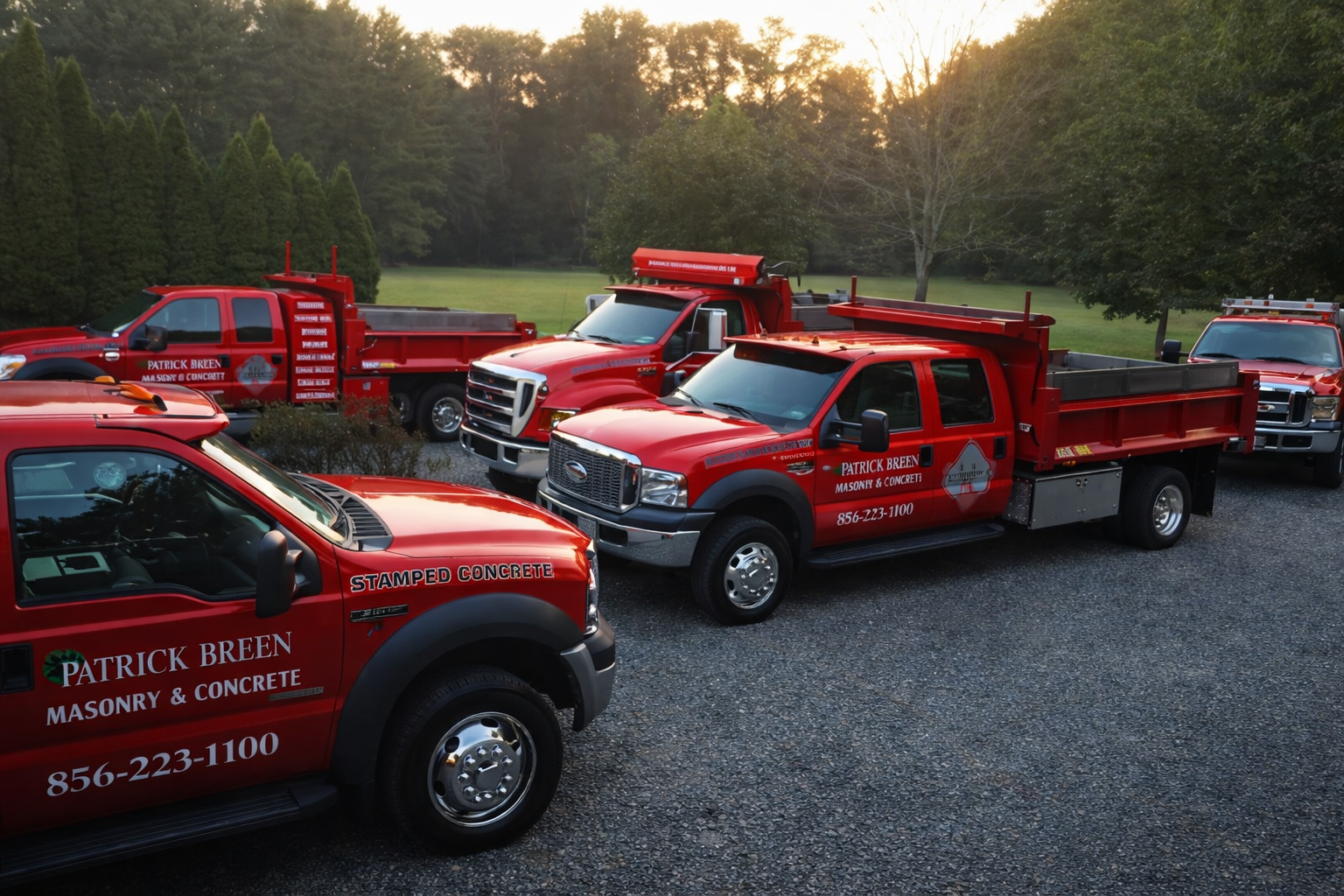
Hiring the wrong concrete contractor is expensive — and permanent. Unlike a bad paint job you can redo for a few hundred bucks, a badly poured patio or driveway is a multi-thousand-dollar mistake that's literally set in stone. After 43 years in this business, we've seen every shortcut, scam, and failure mode. Here's how to protect yourself.
The Red Flags That Should Make You Walk Away
No NJ Home Improvement Contractor Registration
New Jersey law requires any contractor performing home improvement work over $500 to register with the Division of Consumer Affairs. The registration number looks like 13VH followed by 8 digits. If a contractor can't provide this number, they're operating illegally — and you have zero legal recourse if something goes wrong.
How to verify: Search the contractor's name or registration number at the NJ Division of Consumer Affairs website. Takes 30 seconds and could save you thousands.
Cash-Only, No Contract
Any contractor who insists on cash and won't provide a written contract is a contractor who doesn't want a paper trail. A proper contract should include:
Detailed scope of work (not just "pour patio")
Materials specification (concrete PSI, base depth, reinforcement type)
Start and completion dates
Payment schedule with amounts tied to milestones
Warranty terms
Permit responsibility
What happens if they damage your property
Requires Full Payment Upfront
Industry standard is a deposit (typically 10-30% for materials) with the balance due upon completion. Any contractor demanding full payment before starting has no incentive to finish properly — or finish at all.
No Insurance
Ask for their Certificate of Insurance showing both general liability and workers' compensation coverage. If a worker gets hurt on your property and the contractor doesn't have workers' comp, you could be liable. If they damage your home, sprinkler system, or landscaping without general liability insurance, you're paying for repairs.
Don't just ask — verify. Call the insurance company listed on the certificate to confirm the policy is active.
Way Below Market Price
If one bid is 40-50% below the others, something is being cut. Common shortcuts that produce cheap bids:
Thinner concrete (3.5 inches instead of 4-5 inches)
No reinforcement (wire mesh or rebar)
Inadequate base (2 inches of stone instead of 4-6)
Non-air-entrained concrete (guaranteed failure in NJ winters)
No sealer included
Using laborers instead of experienced finishers for stamped work
These shortcuts aren't visible the day the job is done. They show up 2-3 years later when the driveway cracks, the patio heaves, or the surface spalls. By then, the cheap contractor is gone.
No Physical Address or Established Business
A contractor working out of a truck with a cell phone number and no verifiable business address is high-risk. Established businesses with a physical location, a website, and years of history have too much to lose to do bad work.
What to Look For in a Quality Contractor
Experience Specific to Your Project Type
Concrete work is not all the same. A contractor who's great at foundations may have no experience with stamped concrete. A driveway specialist might not know how to build a proper outdoor kitchen. Ask about experience with your specific project type.
Portfolio of Similar Projects
Ask to see photos of completed projects similar to yours. Better yet, ask for addresses of recent local projects you can drive by. The best contractors are proud to show their work.
Google Reviews (and How to Read Them)
Google reviews are the most reliable indicator of contractor quality. But read them critically:
Look at the ratio of 5-star to 1-star reviews. Some negative reviews are inevitable. A contractor with 50 reviews at 4.8 stars is generally trustworthy. A contractor with 10 reviews, all 5 stars, with generic names, posted in a short timeframe, is suspicious.
Read the detailed reviews. Specific mentions of communication, timeliness, quality, and cleanup are more valuable than "great job!"
Check the dates. Recent reviews matter more than reviews from 5 years ago. People and businesses change.
Check other platforms too. Look at Facebook, Yelp, Better Business Bureau, and Angi for a complete picture.
Detailed Written Estimate
A quality estimate should tell you:
Exactly what you're getting — Concrete PSI, thickness, base material and depth, reinforcement type, color names, pattern name, sealer type
What's included — Tear-out, excavation, stone base, pour, finishing, sealing, cleanup, permit (if needed)
What's not included — Extra grading, utility relocation, tree root removal, etc.
Payment terms — Deposit amount, progress payments (if applicable), final payment
Timeline — Expected start date and duration
Warranty — What's covered, what's not, for how long
If an estimate says "pour stamped concrete patio — $5,000" with no other details, that's not an estimate — it's a guess. You have no way to compare it to other bids or hold the contractor accountable for what they deliver.
Proper Licensing and Certifications
Beyond the NJ HIC registration, look for:
ACI Certification (American Concrete Institute) — Indicates formal training in concrete technology
ICPI Certification (Interlocking Concrete Pavement Institute) — Required for proper paver installation
Manufacturer certifications — Techo-Bloc, Belgard, and Cambridge all have authorized contractor programs that require training
Communication Quality
How a contractor communicates during the bidding process is exactly how they'll communicate during your project. If they're slow to return calls, vague in their answers, or dismissive of your questions now — it only gets worse once they have your deposit.
Questions to Ask Every Contractor
Print this list and bring it to every estimate:
What's your NJ HIC registration number?
Can I see your Certificate of Insurance (liability + workers' comp)?
What PSI concrete do you specify? Is it air-entrained?
What base preparation do you use? How deep?
What reinforcement do you include (wire mesh, rebar, fiber)?
How many stamped concrete projects have you done in the last year?
Can I see photos or addresses of recent projects?
Who will actually be on-site doing the work?
What's your warranty? Can I get it in writing?
What happens if there's a problem after the job is done?
The way a contractor answers these questions tells you everything. Confident, detailed answers = experienced professional. Vague, defensive answers = proceed with caution.
How to Compare Bids
You'll probably get 3-5 estimates. Here's how to evaluate them:
Make Sure You're Comparing Apples to Apples
Line up the specs from each bid:
Spec Contractor A Contractor B Contractor C Base depth ? inches ? inches ? inches Concrete thickness ? inches ? inches ? inches Concrete PSI ? ? ? Air-entrained? Y/N Y/N Y/N Reinforcement ? ? ? Sealer included? Y/N Y/N Y/N Warranty ? years ? years ? years
If a bid doesn't include these details, call and ask. You can't compare bids without comparing specs.
Don't Automatically Take the Lowest Bid
The lowest bid often means the lowest quality — cheaper materials, less base prep, thinner concrete, less experienced crews. In concrete work, you genuinely get what you pay for.
The middle bid is often the best value. It usually represents a contractor who uses quality materials and methods but runs an efficient operation.
Trust Your Gut
After meeting with multiple contractors, you'll have a feel for who's professional, knowledgeable, and trustworthy. That instinct matters. You're not just buying concrete — you're hiring someone who'll be on your property for several days with heavy equipment.
What to Expect During the Project
Before Work Starts
Written contract signed by both parties
Deposit paid (10-30%)
Start date confirmed
Utility markout completed (811 call)
Neighbors notified of equipment and noise
During the Work
Crew arrives on time with proper equipment
Work area is contained and organized
End-of-day cleanup (tools organized, debris managed)
Communication about any changes or unexpected issues
Progress matches the agreed timeline
After Completion
Final walkthrough together to inspect the work
Any punch list items addressed
Care and maintenance instructions provided
Final payment upon satisfaction
Warranty documentation provided
Patrick Breen Masonry & Concrete · South Jersey since 1983
Design your patio online in about two minutes
Pick a pattern, colors, size and add-ons and see a ballpark number before anyone visits. Stamped concrete runs $20–$30 per square foot installed across Gloucester, Camden and Burlington Counties.
Why Families Choose Patrick Breen
We've been doing this since 1983 — three generations of the Breen family, not a faceless corporation. When you hire us:
You know who's doing the work. Our crews are employees, not random subcontractors we found last week.
You can check our track record. 43+ years, 2,167+ projects, 4.9-star Google rating. We're not going anywhere.
You get a real warranty. Backed by a business that's been here for four decades and plans to be here for four more.
You get honest advice. Sometimes we tell people their project doesn't need the most expensive option. That's how you build a 43-year reputation.
Call: (856) 223-1100
Patrick Breen Masonry & Concrete — Mullica Hill, NJ — NJ Lic #13VH00144300 — Since 1983