
Stamped Concrete Driveways in South Jersey: Cost, Patterns & Design Ideas
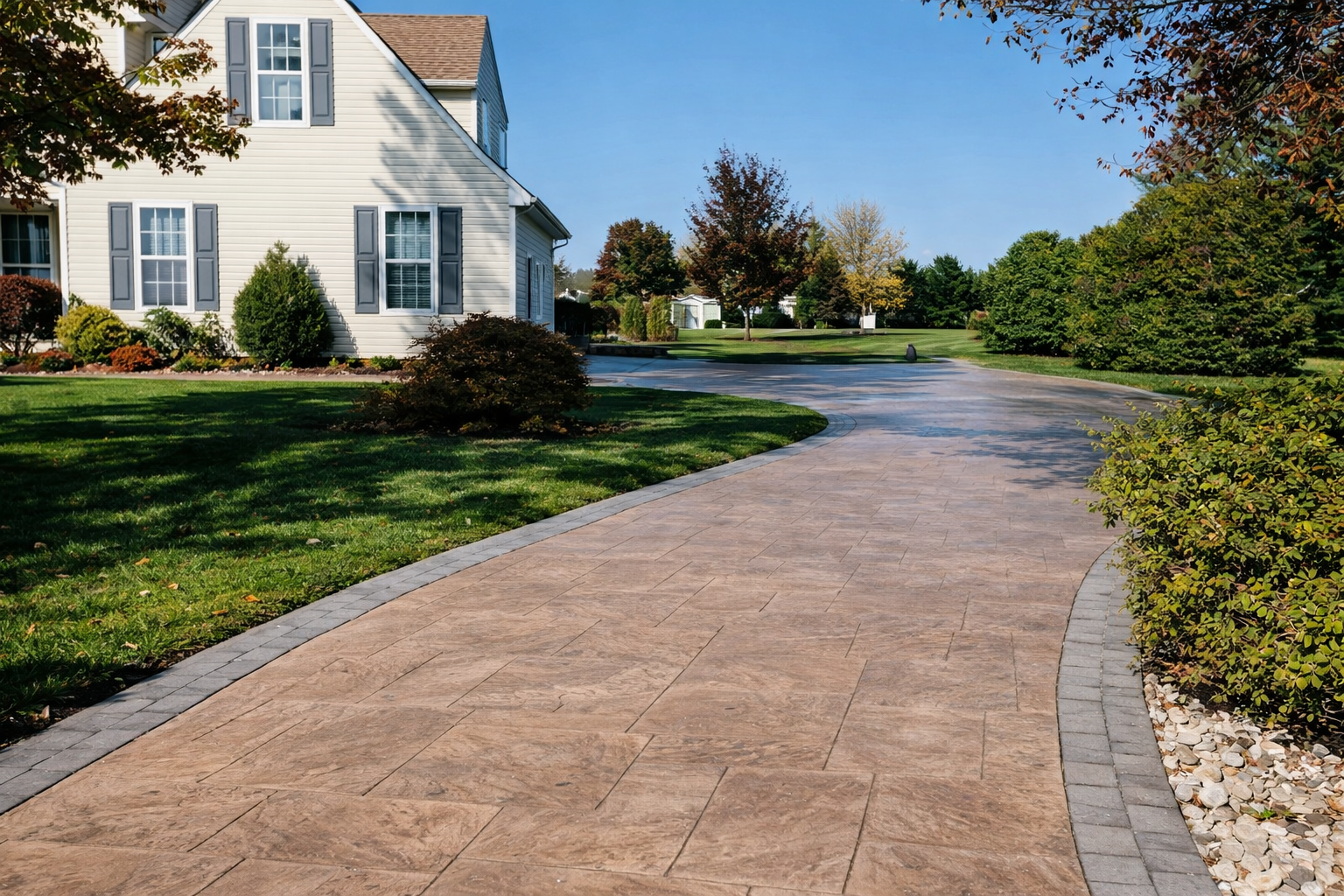
Your driveway is the first thing anyone sees when they pull up to your home — and a stamped concrete driveway makes a statement that plain gray concrete never will. Here's what South Jersey homeowners need to know about stamped concrete driveways, from costs and patterns to installation details and long-term care.
Why Choose a Stamped Concrete Driveway?
A standard broom-finish concrete driveway is functional. A stamped concrete driveway is functional AND beautiful. The difference in curb appeal is dramatic — and the price difference is smaller than most people expect.
Stamped vs. plain concrete driveway costs:
Plain concrete: $7 – $12 per square foot
Stamped concrete: $14 – $22 per square foot
For a typical South Jersey two-car driveway (600 sq ft), the upgrade from plain to stamped adds roughly $4,000 – $6,000. That investment is immediately visible from the street and adds measurable curb appeal to your property.
Stamped vs. paver driveways:
Paver driveways: $22 – $40+ per square foot
Stamped concrete: $14 – $22 per square foot
Stamped concrete saves you 30-45% compared to pavers while achieving a similar high-end look. And unlike pavers, there are no joints for weeds to invade or pieces to shift under vehicle weight.
Driveway Pricing in South Jersey
Real 2026 numbers based on projects we've completed in Gloucester and Camden Counties:
Driveway Size Basic Stamp Mid-Range Premium Single car (300 sq ft) $4,200 – $5,400 $5,400 – $6,600 $6,600 – $7,800 Two car (600 sq ft) $7,800 – $10,200 $10,200 – $12,600 $12,600 – $15,000 Large/circular (900+ sq ft) $11,700 – $15,300 $15,300 – $18,900 $18,900 – $22,500+
What's included in these prices:
Tear-out and removal of existing driveway
Excavation and grading
6-8 inch compacted stone base (driveways need more base than patios)
Wire mesh or rebar reinforcement
5-6 inch concrete pour (thicker than patios for vehicle load)
Air-entrained mix (mandatory in NJ)
Integral color, stamping, and release agent
Two coats of sealer
Cleanup and debris removal
What can add to the price:
Apron and sidewalk integration
Decorative borders
Turnaround or widened sections
Drain installation
Significant grade changes
Extra-long driveways requiring multiple concrete truck loads
The Budget-Friendly Alternative: Stamped Borders
If a fully stamped driveway is beyond your budget, consider the stamped border approach — our most popular cost-saving design:
A 2-3 foot wide stamped concrete border runs along both edges of the driveway, with standard broom-finish concrete in the center. You get the decorative impact visible from the street at roughly half the cost of full stamping.
Typical stamped border driveway cost: $9 – $14 per square foot for the total driveway (border + plain center).
This approach also works great as Phase 1 — you can pour the bordered driveway now and add a matching stamped patio later. The consistent border pattern ties everything together visually.
Best Patterns for Driveways
Not every stamped pattern works on a driveway. Vehicle traffic, tire marks, oil drips, and street visibility all play a role in pattern selection.
Our Top Driveway Patterns
Ashlar Slate — The most popular driveway pattern by far. Clean geometric lines look sharp from the street, the deep texture handles tire traffic well, and the pattern hides minor wear over time.
Cobblestone — Classic and elegant. The small-scale pattern creates a European estate look that's especially popular on curved driveways and driveway aprons.
Herringbone Brick — The angled interlocking pattern is visually striking and historically used in actual road construction for its structural properties. Perfect for brick-front colonial homes.
Large Ashlar / European Fan — A more formal look with larger stone shapes. Makes a dramatic impression on long driveways in Cherry Hill, Haddonfield, and similar neighborhoods.
Patterns to Avoid on Driveways
Wood Plank — The linear pattern can show tire tracks and wear marks more obviously than stone patterns.
Light-texture patterns — Subtle textures get worn smooth by vehicle tires faster than deep-textured patterns. Choose patterns with pronounced, deep impressions.
Color Recommendations for Driveways
Light to medium tones — Hide tire marks and oil spots better than dark colors
Warm earth tones (sandstone, buff, desert tan) — Look clean and age gracefully
Avoid very dark colors — Every tire mark, oil drop, and leaf stain shows
Match your walkway and patio — If you have (or plan to have) stamped concrete elsewhere on the property, coordinate the colors for a cohesive look
Driveway-Specific Installation Requirements
Driveways take more abuse than patios. The installation standards are different:
Concrete Thickness
Patios and walkways: 4 inches standard
Driveways (cars): 5-6 inches minimum
Driveways (heavy vehicles, RVs): 6-8 inches
Base Preparation
South Jersey's clay soils make base prep critical for driveways:
Minimum 6 inches of compacted crushed stone (8 inches in heavy clay areas like parts of Mullica Hill and Washington Township)
Proper compaction in lifts — not just dumped and graded
Geotextile fabric between soil and stone base in problem areas to prevent clay migration
Grading to direct water toward the street or storm drains, away from your garage and foundation
Reinforcement
Wire mesh at minimum for residential driveways
Rebar grid (1/2" rebar on 24" centers) for heavy-use driveways
Fiber reinforcement mixed into the concrete adds additional crack resistance
Control Joints
Driveways need control joints every 8-10 feet (roughly matching the slab width). Joints should be placed to align with the stamp pattern for minimal visibility. On a long driveway, this means multiple joints — each one is a potential crack control point.
Approach and Apron
The transition between your driveway and the street is critical. The apron (where your driveway meets the road) is typically governed by your municipality. In many South Jersey towns:
Harrison Township, Washington Township, and Cherry Hill have specific curb-cut and apron requirements
Permits may be required for driveway replacement that includes apron work
We handle all permit applications and inspections
How Long Do Stamped Concrete Driveways Last?
With proper installation and maintenance:
The slab: 30-40+ years
The stamp pattern: Permanent
The color: Requires resealing every 2-3 years to maintain vibrancy
Surface texture: Will show gradual wear in tire paths after 15-20 years — this is normal and can be addressed with a color-enhanced reseal
The biggest threat to driveway longevity in New Jersey is deicing chemicals. Rock salt (sodium chloride) accelerates surface deterioration. Calcium chloride and magnesium chloride are safer alternatives. Sand provides traction without any chemical damage. During the first winter after installation, use sand only.
Driveway Maintenance
Regular Care
Sweep debris regularly — leaves decompose and stain
Clean oil or fluid drips promptly with a degreaser
Rinse with a garden hose monthly during heavy-use seasons
Seasonal
Spring: Inspect for any winter damage, clean thoroughly, schedule resealing if needed
Fall: Clean and inspect before winter, ensure drainage is clear
Winter: Use sand or calcium chloride only — never rock salt on stamped concrete, especially in the first 2 years
Resealing
Same as any stamped concrete — every 2-3 years. Driveways may need the more frequent end of that range due to vehicle traffic, UV exposure, and chemical exposure from winter treatments.
Driveway Replacement Process
If you're replacing an existing driveway, here's what to expect:
Day 1: Saw-cut and remove existing concrete or asphalt. Haul away debris. Excavate to proper depth and begin base preparation.
Day 2: Complete stone base compaction. Set forms and grading. Install reinforcement.
Day 3: Pour, color, stamp. This is the big day — concrete trucks arrive early morning, and the crew works through the day to pour, color, and stamp the entire surface before it sets.
Days 4-7: Curing period. Stay off the surface. No vehicles for at least 7 days (10 days in cooler weather).
Day 28-30: Final sealer application after full cure.
Total project time: 3-4 working days plus cure time. You'll need to park on the street for about 10 days.
Transform Your Home's First Impression
Your driveway sets the tone for your entire property. A stamped concrete driveway tells visitors — and potential buyers — that this home is cared for, invested in, and designed with intention.
Patrick Breen Masonry & Concrete has been replacing driveways across South Jersey since 1983. We handle everything — permits, tear-out, base prep, pour, stamp, seal — so you just pick the pattern and color.
Build Your Project Online — Select "Driveway" and see your options.
Call: (856) 223-1100
Patrick Breen Masonry & Concrete — Mullica Hill, NJ — Third Generation Since 1983 — NJ Lic #13VH00144300